If thinking is so great—if it's our species' prized survival tool—then why is overthinking even a thing? Shouldn't more thinking always be better? if overthinking is bad, is thinking inherently bad? And if it isn't, does that mean thinking itself is flawed or at least limited and actually non-applicable in some situations?
The set of things that can be classified as 'problems' with 'solutions' is a limited one. Not just NP-hard problems. Thinking seems to work extremely well when we want food, sex, or survival. But not when we are thinking about "where did we come from?", or questions like "is she upset with me?"
My conclusion after (over)thinking this through is that the difference is that one is beyond the realm of what thinking can solve, and the other isn't even well-defined. Both questions reveal the limitations of thinking in different ways. One shows that thinking has its boundaries or at least a nonzero error rate in some sample spaces. The other reveals the compounding effect of a thinking exercise with a non zero error rate, which we see in overthinking.
So, if overthinking is bad, is thinking inherently bad? In a way yes, because solutions that are obtained by thinking are always approximates. But in a way no, because there is little to no return beyond these approximates. Daniel Kahneman, in Thinking, Fast and Slow, shows how our brains lean on fast heuristics—quick, efficient guesses that work "well enough" They're not wired for perfect reasoning. They're wired for survival. Speed is quite important to optimize for in the real world. Anil Seth calls perception a "controlled hallucination"—our brain's best-guess model stitched together from scraps of sensation. So then thinking is erroneous by nature because it isn't triyng to optimize for the truth at all. This makes reasoning and logic sound like an arm or a tail. Like a feature we use to navigate the world. Like an eagle's eye or a dog's nose, in the way that they are overdeveloped and aide their way of living.
What Actually Causes Errors in Thinking
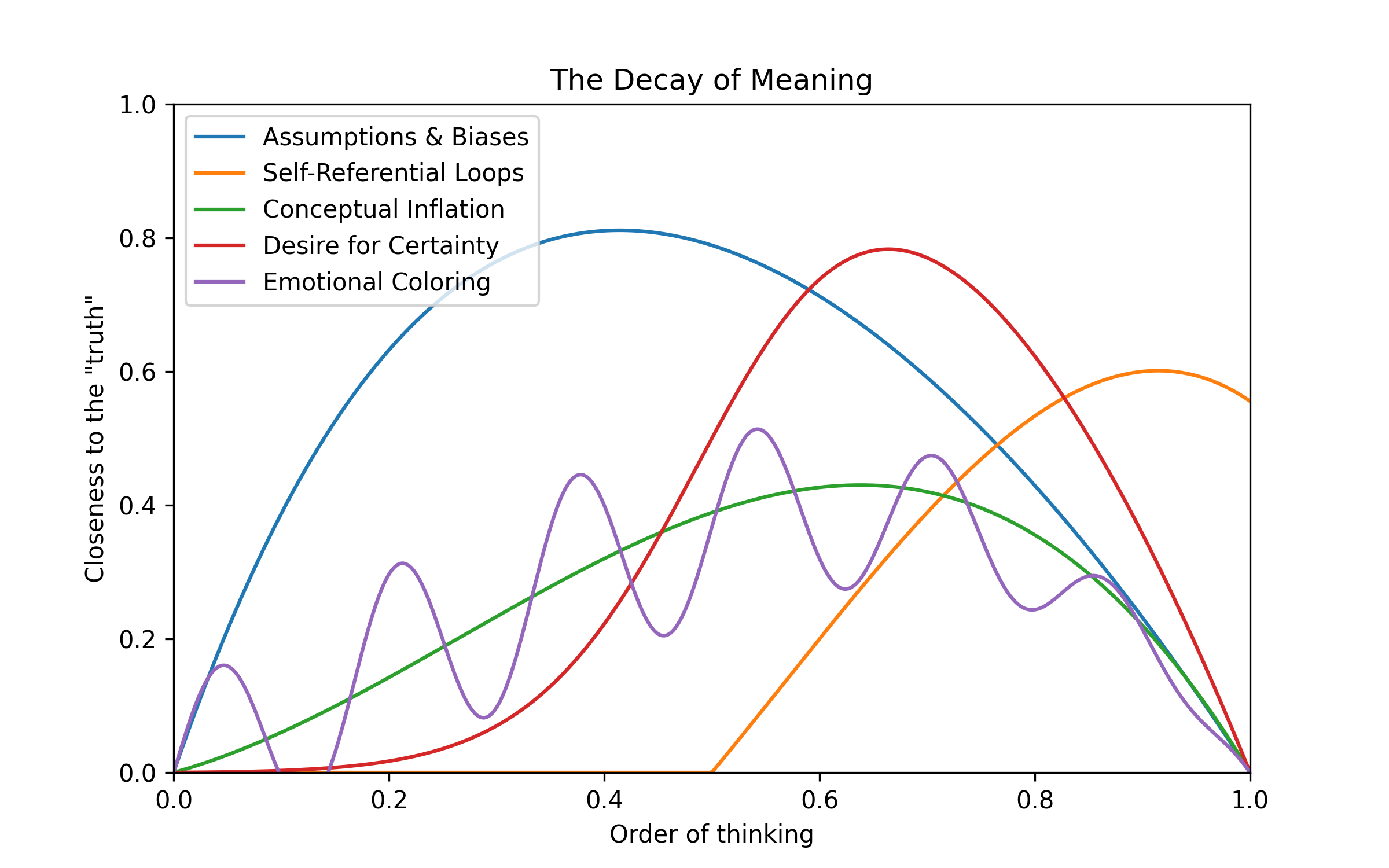
Overthinking isn't just "extra thinking" It's when natural components of thought—good in moderation—start looping, inflating, and detaching from reality:
- Assumptions and Biases: We fill gaps automatically. Wrong assumptions get inherited and amplified with every new layer of thought (especially seen when answering "is she upset with me?", which cannot be answered without some assumptions).
- Self-Referential Loops: Reflection that folds inward without anchoring to the outside world.
- Conceptual Inflation: Abstractions stack up and replace concrete realities.
- Desire for Certainty: We invent clarity because we can't stand ambiguity.
- Emotional Coloring: Strong emotions make some ideas "feel" more real than they are. Or when it's your siblinig/ spouse, it's harder for you to believe that they committed a crime, yet many criminals have siblings/ spouses (who never had an idea)
This is why each curve looks the way that it does Chain a few guesses together and errors don't just add — they explode. Psychologists call this exponential-growth bias. (Wagenaar & Timmers, 1979)
Self-Referential Loops (Stable, then sudden death)
Reflection starts fine, but if it keeps folding back on itself, it breaks. One get paradoxes and logical feedback loops that trap you — like the strange loops Hofstadter's Gödel, Escher, Bach (1979) talks about this. Chapter 6 is one place.
Every abstraction steps one layer away from reality. Stack enough layers, and you end up thinking about your thinking about a metaphor about a guess. See Baudrillard’s Simulacra and Simulation (1981).
Desire for Certainty (Steep middle curve)
Brains hate ambiguity. Prospect theory shows we distort probability to feel safer — especially around "almost certain" and "almost impossible" situations. (Kahneman & Tversky, 1979)
When emotions get involved, reasoning goes wobbly. Hot-cold empathy gaps show how badly we predict our own future feelings. (Loewenstein, 1996.)
I overthought a little too hard
The Curves Are Fine, Actually (No, They're Not)
Assumptions & Biases (Sharp early collapse)
Self-Referential Loops (Stable, then sudden death)
Conceptual Inflation (Slow drift)
Desire for Certainty (Steep middle curve)
Emotional Coloring (Wobbly noise)
These features aren't extra baggage. They are baked into thought itself. We can't actually think about anything without using at least some assumptions or biases. For example, when we try to use Newton's law of motion to predict where a ball is going to end up, we are definitely assuming that the earth is not going to undergo a massive change in its gravitational field. But it can happen. But this assumption is actually smart. When your friend tells you they are bringing some of their friends to a party, you can safely assume it's not 1000 friends. But your friend never said that and logically they can do that. But this assumption is also smart. But there is a point after which you would actually be stupid to assume. Like assuming that you will love them all because your friend is lovely (emotional colouring).
Not all thinking behaves the same. Ideal thinking is when the system to solve is a well-defined one (no. of unknowns ≤ degrees of freedom) — most of the math we learned at school. Fun to solve because there always was an answer. Overthinking is when you attempt to use the same methods to solve a system where it isn't well defined (degrees of freedom > no. of unknowns). And then you try to work with it somehow by making too many assumptions and other error-inducing tools that you absolutely need to even begin thinking about it. It loops, amplifies noise, detaches from reality. The outcome of such an exercise really loses its confidence. Overthinking feels bad because it's decoupled. No new information. No terminal condition. No collapse of uncertainty.
How to Spot Overthinking
- Is new information entering?
- Is uncertainty shrinking?
- Is action becoming possible?
If not, it is probably overthinking, i.e., thinking isn't helping anymore. Unless some new certainties are introduced.
What Thinking Was Always Meant to Be
So if thinking isn't about getting to one truth, and there are only relative, sensible truths, maybe it is safe to say that thinking isn't the path to an ultimate truth. And since all that we think only exists in the realm of thinking itself, then for all human purposes, there is no absolute truth.
The more we treat thinking as sacred, the more ridiculous we sound. Treating science like religion then becomes like treating religion like religion. Because the very process we rely on — thinking, logic, abstraction — is stitched together with shortcuts, assumptions, and evolutionary hacks. It's a kludge. It works astonishingly well for survival. For food, sex, safety, connection. But indulging in endless intellectual masturbation is counterproductive. Also, drips with human hubris.
Knowing When to Stop
The real grace then seems to lie in knowing this. In acknowledging the realm of thinking isn't all-encompassing. Also, in thinking just enough: to build meaning where it matters, to survive a little better, to love a little deeper. And then stopping.
If you find yourself wondering whether you're still overthinking, you probably are. But now you know. Should you start thinking whether you're at least overthinking less, consider it a sign to close this tab.